When you click on links to various merchants on this site and make a purchase, this can result in this site earning a commission. Affiliate programs and affiliations include, but are not limited to, the eBay Partner Network.
why are most aftermarket upper manifolds "all-open" and do not separate primary and secondary runners like oem? doesn't this affect low-end tq and drivebility ?
yes, it does.
for example F1 cars use a sliding plenum but only one intake plane. rotaries use a dual plane intake with longer secondary runners, because it is needed for low end torque which the rotary already sorely lacks. if it was easily possible to seal a sliding intake manifold for use in turbo applications i think that would be the best method.
for a real question, would a turbo rotary benefit from a totally divided intake manifold? i have never seen anyone try that. much the same as i haven't seen anyone try to fabricate an expansion pipe for the exhaust.
these are ideas that should be attempted, instead of trying to reinvent the wheel. manifolds like this only shift the power band but don't really make the car any faster other than on a dyno. so if you want a dyno queen, i guess stay tuned.
honestly i think the stock intake manifolds are fine for anything sub 600whp, changing it up for something new is just a waste of energy.
back when i built small blocks, it was kind of fun to tinker with different setups. but those changes were a couple a hundred bucks, not a couple thousand. they were also common enough with competition that you could find used upgrade parts for a fraction of the price, like $50 for an edelbrock performer manifold. sure it raised the powerband, but overall they barely made a difference when it came to twisty road driving.
Last edited by notanymore; May 16, 2025 at 10:16 AM.
The lower is still divided on the turbosource manifold. Typhoon has a much later division for the lower.
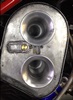
Pictures are just for a visual comparison of OEM vs non ported Turbosource, vs Typhoon. You can see how massive the typhoon is, vs the Turbosource being almost OEM sized relying on shape for gains.
Turbosource will be go going on a car that had an aggressively ported OEM upper, and then raced in Siam GT PT Manxitron series. It will be a good comparison of modified OEM vs aftermarket manifold. Team Rotary Revolution will be campaigning 6 cars this year, in Pro, Pro II, and Amateur classe, all on the grid together. 12 laps flat out. Rest of the grid is mostly EVOs, very very fast EVOs.
13B-RE Cosmo (or Elite) is missing from the comparo, I wonder how the larger primary runner size tapering to the smaller primary port affects flow compared to REW LIM (or Xcessive or Turblown's). Also the upper is fully divided but with a collector style instead of the U shape to direct the pulses... hmmm
I think we might have a real Cosmo upper to compare. I’ll ask.
I was told it won’t make as much power as an FD UIM. It’s an earlier design and simply isn’t as efficient. But people love the look, like a 2/3rd 3 rotor, and of course the rarity of the original part.
I just had a look on a Elite LIM.. imo the thinking was put aside when that chunk of alu was cast... like if one were to do all the effort to cast a manifold one would think placing the injectors in the enter of a runner could be logic sense.. now all 4 injectors and especially the secondary ones are very offset and the secondary ones will just spray down the wall instead of giving them the chance to atomise. Then I thought ok maybe it has to fit a stock rail but then it having 4 injectors blew that idea also away. The rail that comes with it is Elite branded so that would have been easy to adjust and sell as a kit.
The flange was also about 1mm from straight and looks as if had been surfaced by a handheld sander machine (like one would use for bodywork). ports were also offset by approx a mm and the semi PP were apart from being very small also approx 2mm below the center of boss on the rotor housing.
We recently had the chance to see our FC3S semi pport lower in action vs an OEM modified unit( which was done as nice as you can ).
Same dyno, same tuner, only two changes; ECU + our new semi pport FC lower intake manifold. This was not the same day back to back however. Same AFR/Split/Ignition advance etc. 50rwhp jump, at 1 to 1.5 psi boost less( final run was 27 psi midrange, fading to 22 psi by redline, peak torque was at 26 psi, and peak rwhp at 24 psi).