


Brake Bias and prop valve questions for road racing


Thread Starter
Mazzei Formula
iTrader: (6)
Joined: Jun 2006
Posts: 3,021
Likes: 145
From: Birmingham, Al
Brake Bias and prop valve questions for road racing
Hi,
Currently setting up the car for the racetrack. Road Atlanta, Talladega small track, and Barber Motorsports
The setup will be:
Brembo F50 4piston front brakes on 345mm rotors, ducted with 2.5in duct to custom backing plate
OEM rear brakes
Wilwood Dual Reservoir Manual Master Cylinder
Now,
I've read that the fd3s is inherently 68% front biased from the factory. I see people running prop valves, on abs delete kits, but the prop valve is typically placed on the rear line. So to me, it would mean that slowing off the rear brakes would give even more front bias. So then the general desire around here is that drivers wish to have less rear brake on oem brake setups? The driver and team we are working with only has experience with bias bars and true dual master cylinder setups so using a prop valve is new to all of us
however,
when we move to the larger front brake setup, with larger pistons, this should dramatically increase the front bias. Would it not make more sense to run a prop valve on the front brakes, so as to help calm the front brakes down and overcome this bias of upgraded fronts? Or better yet should we consider running front and rear prop valves?
the platform is a 4 rotor turbo engine, overall weight is 2900lbs, 50 50 distribution, 14kg front 12kg rear spring, 3 degree front camber negative 2 degree rear negative. 250/640 and 280/680 yokohama slicks, and approximately 1000rwhp through a 4 speed dog box
What are you guys experiencing with upgraded front brake kits and bias?
Our goal is to be able to keep the rear brakes heavily active but not lock up, so that we can trail brake. And be able to dial in and out on the track. Depending on the bias, pad friction front to rear type will be chosen to aim for ideal ratio. We just havent had any experience in this car to get an initial game plan.
thankyou
Currently setting up the car for the racetrack. Road Atlanta, Talladega small track, and Barber Motorsports
The setup will be:
Brembo F50 4piston front brakes on 345mm rotors, ducted with 2.5in duct to custom backing plate
OEM rear brakes
Wilwood Dual Reservoir Manual Master Cylinder
Now,
I've read that the fd3s is inherently 68% front biased from the factory. I see people running prop valves, on abs delete kits, but the prop valve is typically placed on the rear line. So to me, it would mean that slowing off the rear brakes would give even more front bias. So then the general desire around here is that drivers wish to have less rear brake on oem brake setups? The driver and team we are working with only has experience with bias bars and true dual master cylinder setups so using a prop valve is new to all of us
however,
when we move to the larger front brake setup, with larger pistons, this should dramatically increase the front bias. Would it not make more sense to run a prop valve on the front brakes, so as to help calm the front brakes down and overcome this bias of upgraded fronts? Or better yet should we consider running front and rear prop valves?
the platform is a 4 rotor turbo engine, overall weight is 2900lbs, 50 50 distribution, 14kg front 12kg rear spring, 3 degree front camber negative 2 degree rear negative. 250/640 and 280/680 yokohama slicks, and approximately 1000rwhp through a 4 speed dog box
What are you guys experiencing with upgraded front brake kits and bias?
Our goal is to be able to keep the rear brakes heavily active but not lock up, so that we can trail brake. And be able to dial in and out on the track. Depending on the bias, pad friction front to rear type will be chosen to aim for ideal ratio. We just havent had any experience in this car to get an initial game plan.
thankyou
Thread Starter
Mazzei Formula
iTrader: (6)
Joined: Jun 2006
Posts: 3,021
Likes: 145
From: Birmingham, Al
ok i answered my own question
The stock bias is achieved with a valve in the OEM ABS system. When the ABS/stock master cylinder is removed, the bias is whatever you wish it to be when utilizing a prop valve
Upgraded to a wilwood master cylinder, deleted the ABS, and using a wilwood prop valve. Supplied all by Chase Bays. Full extension is 40% rear fluid partition, full lock down is 90% fluid to the rear. So you are able to widely change bias if you go away from ABS and Brake Booster.
The stock bias is achieved with a valve in the OEM ABS system. When the ABS/stock master cylinder is removed, the bias is whatever you wish it to be when utilizing a prop valve
Upgraded to a wilwood master cylinder, deleted the ABS, and using a wilwood prop valve. Supplied all by Chase Bays. Full extension is 40% rear fluid partition, full lock down is 90% fluid to the rear. So you are able to widely change bias if you go away from ABS and Brake Booster.


Thread Starter
Mazzei Formula
iTrader: (6)
Joined: Jun 2006
Posts: 3,021
Likes: 145
From: Birmingham, Al
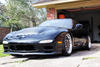
i haven't yet driven either haha but will update soon! My friend pushed me really hard into doing it. He drives IMSA and alot of other cars. Biggest advantage, he claims, is the ability to maintain a consistent and repeatable braking pressure throughout a lap. Whereas on a booster car, he claims that the pedal travel / pedal feel will vary according to vaccuum/rpm and speed. The manual will supposedly feel like you are pushing against a solid wall, making it easier to sense your degree of force upon the brakes. While on a boost, the pedal will always have travel, and vary in degree of travel, making it difficult to maintain consistency. The downside to the manual swap is increased effort required to lock up all 4. But he also claims this reduces risk of locking up as you really have to "ask for it". Im stoked to find out. Should prove interesting. I think the master we went with is a 0.81"


Thread Starter
Mazzei Formula
iTrader: (6)
Joined: Jun 2006
Posts: 3,021
Likes: 145
From: Birmingham, Al
After we get data on and see how well the car puts up with track abuse, if we decide this car is worth running more frequently, the next step will be installing the Bosch Motorsports ABS unit. But for now, the goal is to keep it simple until after shakedown. There's probably a slew of things that we'll need to reconsider after the first run

Thread
Thread Starter
Forum
Replies
Last Post
Max_Spd
Suspension/Wheels/Tires/Brakes
17
Aug 10, 2010 09:41 PM
Gregs
1st Generation Specific (1979-1985)
45
Nov 8, 2006 01:36 PM
Relisys190
2nd Generation Specific (1986-1992)
5
Mar 22, 2004 11:40 AM