When you click on links to various merchants on this site and make a purchase, this can result in this site earning a commission. Affiliate programs and affiliations include, but are not limited to, the eBay Partner Network.
Hey guys!
I've recently joined the forum and the car world. Tinkering with machines and mechanical engineering seems to run in the family so I hope I won't get myself into too much trouble. Just cut me some slack if I'm a little behind the curve. I have to say that the project is more exciting than the finished thing.
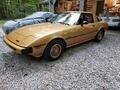
So, I've recently bought a 1971 616. It's not a RX7 or even a rotary engine - I'm sorry! BUT its a mazda and its got a heart of gold.
Needs a little body work but that may be last on the list.
I've replaced a brake rotor and front and rear suspension with KYB struts and springs that the previous owner threw in. I rebuilt the Carb because it was having idle problem at lower RPMs.
I was in the midst of investigating a problem the car was having climbing inclines. I handed it over to a mechanic to expedite a diagnosis. BIG MISTAKE. I should have come to you guys. He gave the car back to me with more problems than before. The newest problem to solve is that I will take the car out and 45 seconds to 2 minutes into driving it will hiccup, sputter a bit and then lose all acceleration power. Now, if I stop on the side of the road, wait for another minute and then continue driving again I will have another window of time to drive. So I have changed the distributor cap, rotor, and installed petronix. I put in new NGK spark plugs, and NGK spark plug wires since the old ones were arcing a bit. I replaced the ignition coil last year. Then I moved on to fuel supply. I emptied and cleaned the gas tank. I replaced the fuel filter. Now the fuel pump was replaced by this mechanic - just fyi. I think I've ticked off most of the obvious stuff. I suppose now I should investigate the electrical writing?
Sorry for the long winded introduction!
I will attach some more pictures of engine bay soon
May I say first of all, congratulations on scoring such a cool car! I love Rx-2s and I somehow failed to realize that the 616s were available here. You found that in NY? I certainly look forward to seeing more reports on this thing. You/your car has a fan in me.
Next on the agenda is the gratuitous "you need a rotary in that thing"-comment. Sorry ... had to do it, but now it's out the way.
Now ... on to your issues ...
What pump did the "mechanic" put in it? And likewise, what are the fueling requirements for the carburetor? Sorry, I know nothing about the specs for those old Mazda engines. What is it ... a 1300?
You said you rebuilt the carbie, so (no disrespect to you) that's where I would start. Maybe recheck the floats and needle setup. Have you checked to see what the plugs are telling you after one of those episodes?
Thanks diabolical1!
I appreciate the welcome and thanks for the support!
I may think about a rotary down the road but figure i should get as many kinks ironed out first ha.
It is a 1600 1.6L OHV I4. The fuel pump is supposed to be supplying 1,000cc/min. He speced out a fuel pump that was over delivering on that. To be honest I haven't investigated the pump further - so I will run a test on the volume of that.
I hear you on the needle and float - I will reinvestigate that. However, after I rebuilt the carb the car ran fine for few months - up until my mechanic encounter and he claimed not to have touched it. It may be neither here nor there but every time I look at the carb fuel bowl (its got a glass bowl cover with level markings) the fuel level is where it should be.
I have checked the plugs and paradoxically they show to be burning a richer mixture.
Well if you had it running fine after the rebuild, but prior to the mechanic's intervention, then I would tend to think the carbie is a less likely suspect. I'm thinking maybe a volume and/or pressure issue.
Originally Posted by Harder616
The fuel pump is supposed to be supplying 1,000cc/min. He speced out a fuel pump that was over delivering on that.
If he installed "too much" pump, then maybe just put a decent regulator and gauge in the system.
I see you have a shop manual. See what pressure your carb requires and then go from there. Although, to be honest, your description of the issue sounds more like you're not getting enough.
That's what I thought too - sounds much more like an issue of too little volume or pressure.
I will do a few tests on it this weekend and report back. I still think the electrical should be on the table since it drives for a period of time and then dies which could be something just barely making contact or a faulty relay that Im not aware of.
I was the guy responsible for bringing your car from Washington State to New Jersey. It is a solid/Rust Free example of a 616. I put the wheels on and sold it. Definitely make it rotary. But, if you do, please source actual Rx2 parts to make it happen. For example, Pedal Set, Engine Mount, RX3 or RX4 trans-Bottom Starter(preferred), ETC.... With time you will build it right. Don't butcher this car. do it right. Good Luck my friend.
This project went quiet but I’m trying to pick it back up. Since the carb is a likely problem, I was looking at replacing with a Weber. What am I looking for in the conversion kit?
no worries. i just wish it had proven to be helpful.
as far as the question about the Weber is concerned, i only dug into it far enough to see that the 1600 you have is at least "related" to the 1600 in the B1600 truck. for that, i found DGEV kits like THIS, but i don't know if that's what you had in mind.
my guess is if you're looking for DCOs or IDA/IDFs, then you may be looking at a custom manifold. however, you may want to check European or Australian vendors, because they are crazy enough to have stuff like that available.
no worries. i just wish it had proven to be helpful.
as far as the question about the Weber is concerned, i only dug into it far enough to see that the 1600 you have is at least "related" to the 1600 in the B1600 truck. for that, i found DGEV kits like THIS, but i don't know if that's what you had in mind.
my guess is if you're looking for DCOs or IDA/IDFs, then you may be looking at a custom manifold. however, you may want to check European or Australian vendors, because they are crazy enough to have stuff like that available.
I was able to test the fuel pump this past weekend.
it came out to being closer to 2000cc/min. Would this not be regulated by the needle in the float bowl though?
I will try a regulator in the fuel line next.
I also realized that the problem occurs when I accelerate and then brake: the engine quickly stalls. I checked the air pump which is tested well but the anti-after burn valve seems to not to be working which keeps fresh air pumping to the carb after decelerations - seems like it could be a contributor.
I have seen that Weber you sent. That is all I’m looking for! I don’t know the difference between the DGV and IDA/IDF carbs. Is it just the physical specs/fit that these conversion kits are tailoring to? I assume that the B1600 would use the same engine and therefore need the same carb mixture.
I know this is a rudimentary question but if I go for the Weber carb do I in turn nullify some of the Anti-pollution system (which seems quite experimental in this model anyway)??
I was able to test the fuel pump this past weekend.
it came out to being closer to 2000cc/min. Would this not be regulated by the needle in the float bowl though?
ideally? yes. however, i think that changes if the pressure is too high. also, if it's not truly seated, then that can be an issue as well.
regulators and gauges are relatively cheap, and they can be great tools when working with a finicky carb.
I don’t know the difference between the DGV and IDA/IDF carbs. Is it just the physical specs/fit that these conversion kits are tailoring to? I assume that the B1600 would use the same engine and therefore need the same carb mixture.
I know this is a rudimentary question but if I go for the Weber carb do I in turn nullify some of the Anti-pollution system (which seems quite experimental in this model anyway)??
thanks a lot for the response
the differences are not really relevant per se. i just wasn't sure what you were thinking when you said Weber. in broad strokes, the DGEV carbs are meant to use with stock manifolds and stock to mild engines. the others that i mentioned are more performance- and race-oriented, two-barrel carbs that may or may not have chokes. my friend and i put one of those DGEVs on his '81 Corolla many moons ago, and if i recall, it deleted a lot of the OEM emissions stuff. however, we also put a header on the car, too, so i don't remember what went due to the carb and what went due to the header. suffice it to say, you will likely have to delete some things with the Weber, if you go that route.
Thanks for all the info. I see the differences now.
Originally Posted by diabolical1
however, we also put a header on the car, too, so i don't remember what went due to the carb and what went due to the header. suffice it to say, you will likely have to delete some things with the Weber, if you go that route.
how did you get the headers done? Did you get them made at a shop or buy a kit?
i know for sure he bought them because i remember him taking them out the box, and as i sit here typing this, i remember the smell after the first fire as the paint started burning off it. i don't remember what brand they were though. Pacesetter/Monza, maybe?
You were right on with the B1600 kit! It fit great. So thanks for the recommendation!
yeah the firing order is nice haha.
The Weber caused me to delete this “accelerator switch” which was an electric switch only activated by more than half throttle. It seems to be signaling to air pollution control but no idea what.
also there is a steel cable that goes into the transmission that I can figure out the purpose of. It was attached to throttle linkage on old carb.
Last edited by Harder616; Oct 16, 2020 at 12:36 PM.